Background and history
The National Forest Condition Survey is a procedure harmonized at both the European and national level, designed to comprehensively describe and numerically represent the vitality status of forest trees in both quantitative and qualitative terms. The survey measures crown thinning and other parameters, such as fruit production. Any tree damage is systematically described, and its extent is determined.
Based on this sample, area-representative information on the health status of forests is obtained. The inventory is conducted annually. In addition to the national analysis (forest condition reports from the federal government and the states), both the raw data and highly aggregated results are compiled on a Europe-wide basis. In Germany, the National Forest Condition Survey and the National Forest Soil Inventory (NFSI) in the forest always coincide at an inventory point, and in some federal states, the inventory points of the Federal Forest Inventory coincide as well.
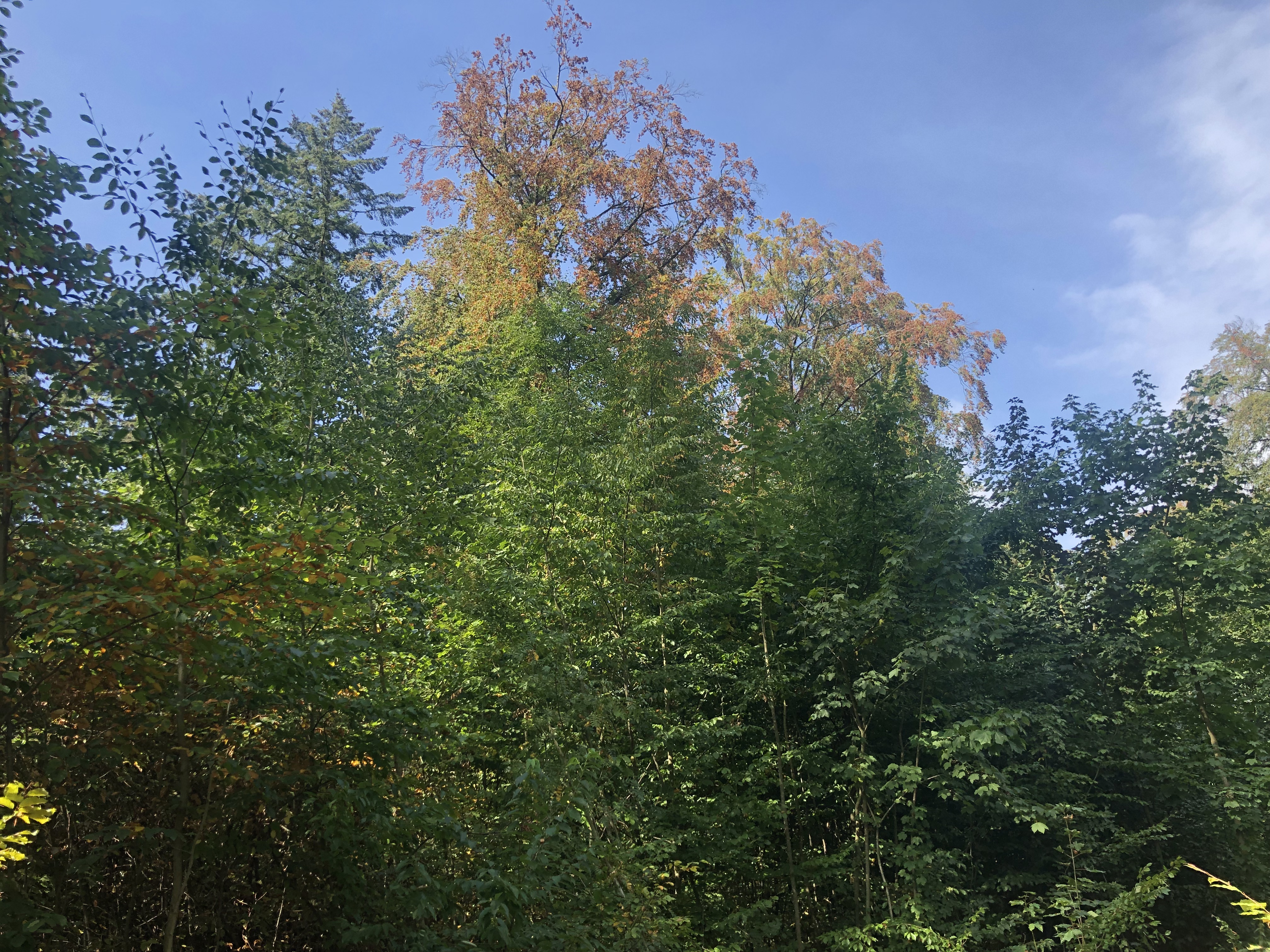
Development of the National Forest Condition Survey
The development of forest condition surveys in Germany and Europe can be traced back to the problem of forest damage caused by air pollution during the last century (Wellbrock et al. 2016).
As a result of the 1979 Geneva Convention on Long-Range Transboundary Air Pollution of the United Nations Economic Commission for Europe (UNECE), the “International Co-operative Programme on Assessment and Monitoring of Air Pollution Effects on Forests” (ICP Forests) was launched in 1985. These international agreements require member states to submit annual reports to the UNECE.
In West Germany, the systematic sample inventory (Level I, 16 × 16 kilometers) was introduced in 1984. The German Democratic Republic (GDR) followed suit in 1986 with the Ecological Forest Condition Monitoring Program (Ökologische Waldzustandskontrolle), or ÖWK for short (Kallweit 2016). Since 1990, a sample inventory based on the model of the current Forest Condition Survey has been conducted nationwide (Seidling and Bolte 2009).
Division of responsibilities between the federal government and the states
From the beginning, forest environmental monitoring in Germany has been viewed as a joint responsibility of the federal government and the states.
The state-run forestry research institutions set up the monitoring network, collect data, and compile state-level datasets, analyses, and reports. The data collection and state-level analyses are generally funded by the states.
At the federal level, the BMLEH’s forestry research division (the BFH until 2008, since then the Thünen-Institute) is responsible for coordinating the inventories, processing, analysis, and reporting of a comprehensive dataset. Reporting obligations to the UNECE or the EU are fulfilled by both the federal states and the federal government.